

- Best Indoor Cycling Certifications: Compare the Top Instructor Programs - August 20, 2026
In more ways than one, there’s no better exercise than cycling. It’s something that’s accessible to people of all skill levels, and unlike other cardiovascular training like running, it’s low-stress on your joints.
If you’re someone who loves cycling, you’ve no doubt done your best to inspire others to take up the hobby, and you may even already share the experience with friends. The only way to make a major impact, though, is to teach. It’s truly the case that doing a job you love means you’re not really working at all, and instructing cycling provides you with one of the healthiest, most rewarding careers available.
Given the flexibility an indoor environment provides, indoor cycling specifically is beloved for its simplicity and high versatility, but there’s a surprising amount you need to learn before you get qualified beyond being a bike geek.
Let’s talk about the best indoor cycling certifications and how to get started by helping you narrow down which path is best for you.
What Makes a Great Indoor Cycling Instructor?
If you’ve already conducted some research into teaching indoor cycling, you’re likely feeling the burden of information overload. There are many ways to go about it, and things can get overwhelming fast.
To start with, it helps to flip the script. As opposed to considering what you need to look for in a course or certification, what is an employer looking for in a cycling instructor?
Safety and Exercise Science
First, any employer needs to know you’ll execute lessons safely. This is the foundation of any fitness class, so whichever course you choose should fully cover the basics.
This includes elements like bike setup and care, as well as exercise physiology as it pertains both to the type of exercise you’ll be doing and indicators that someone is struggling and needs help.
Knowledge here offers insight into different intensity levels, for example, so that you know only to push a given client as much as they need without going over the top.
Cycling Metrics and Technique
You’ll also need clear grounding in cycling metrics. While you may already have a decent working understanding of cadence, resistance, and so on, you’ll be required to possess a much deeper knowledge base than your average hobbyist.
People will be paying you to participate in a cycling workout that’s as optimal as it is safe, and you must be dialed in on a range of complex concepts to offer that.
Coaching and Motivation
Of course, it’s not all about cycling knowledge and adherence to key safety matters. As with any environment where you’re tasked with getting people to do difficult things, you need to be personable, motivating, and compassionate.
A huge part of what people keep coming back for is you; it’s the instructor’s ability to build rapport and connect with each participant that makes sessions fun and rewarding.
Employers will be looking for personability and enthusiasm during an interview, and in this sense, they’ll be assessing your personality and passion just as much as your qualifications.
Creativity and Class Design
The role also necessitates a fair amount of creativity – likely more than you expect. Given the freedom cycling offers when performed outdoors, you’ll need to think outside the box to keep sessions interesting. No two sessions should be completely the same, and you might use simulation techniques (both mental and via dedicated software), writing sessions to music (mapping), and so on, to keep things interesting.
CPR/AED and Continuing Education
Finally, the main providers discussed below (ISSA, NETA, and AFAA) each require instructors to hold a CPR/AED certification before they begin teaching, so employers will be looking for this. Certifications must usually be renewed every couple of years, too, and you’ll do this by completing small training modules called ‘continuing education units’. Prospective learners should be aware of this commitment before training.
The Best Indoor Cycling Certifications (At a Glance)
| Certification | Best For | Format | Price | Key Focus |
| ISSA Certified Indoor Cycling Instructor | Most people | Online, self-paced | $639 or $53/month | Cycling science, metrics, coaching, music |
| NETA Indoor Group Cycling | Budget-friendly option | Workshop + exam / on-demand options | $299 | Essentials, physiology, bike setup |
| AFAA G.E.A.R. | Teaching and class structure | Online | Varies | Music, rhythm, programming, session feel |
| Group Fitness Certifications | Beginners to teaching | Varies | Varies | General teaching and coaching skills |
| ICG Courses | Specific ICG equipment | Varies | Varies | Equipment-specific instruction |
1. ISSA Certified Indoor Cycling Instructor
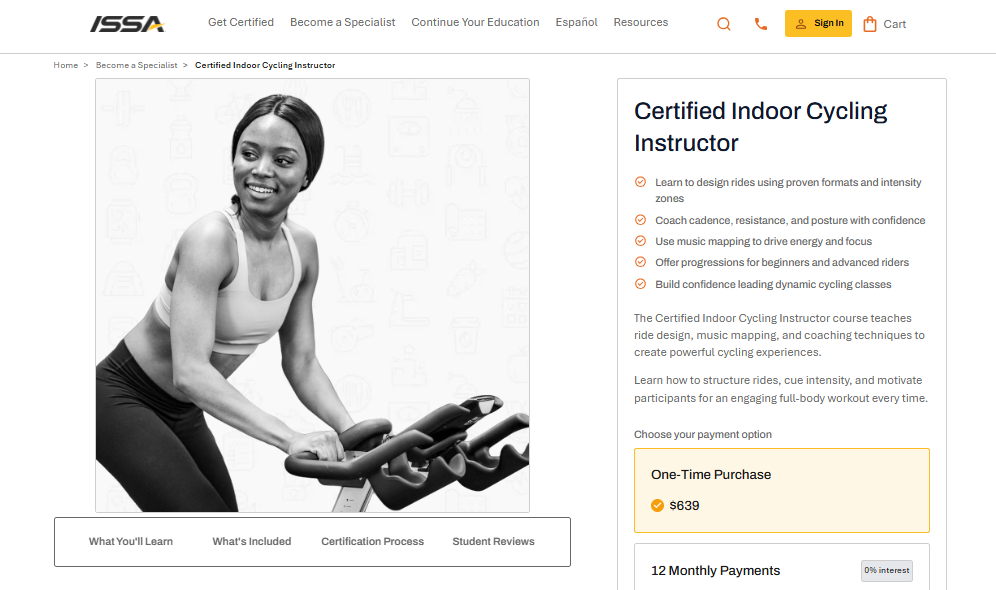
When it comes to indoor cycling certifications, we’d recommend ISSA for most people. Their Certified Indoor Cycling Instructor certification offers fantastic bang-for-buck, as it enables those who qualify to gain the skills they need to train both beginners and advanced riders across a range of different exercise formats. It also provides dedicated instruction on key tools, like using music, and coaching on cycling performance metrics such as cadence, intensity, resistance, power, and more. You’re able to take your final exams at home via their online system, too, which makes everything highly convenient and less stressful.
The course is priced at $639 if you pay in full, but you can also choose a 12-month payment plan with monthly installments. This comes to $53 per month.
As well as the flexibility of scheduling your exams online, the program is completely self-paced, meaning you can study for it as and when you want to. As such, someone with a lot of time on their hands can complete the program quickly and reap the benefits of getting a head start on their journey as an instructor. On the other hand, someone with a much busier life can complete the program over a time frame that suits them, without pressure.
ISSA’s offering is an ideal option for people who want a grounding in the basics with multiple pivot points. Given the breadth of the teaching material (spanning a 3D animation library, a detailed digital textbook, quizzes, and more), the instructor can start where they need to with whichever area of indoor cycling tuition they’re most interested in.
2. NETA Indoor Group Cycling Certification
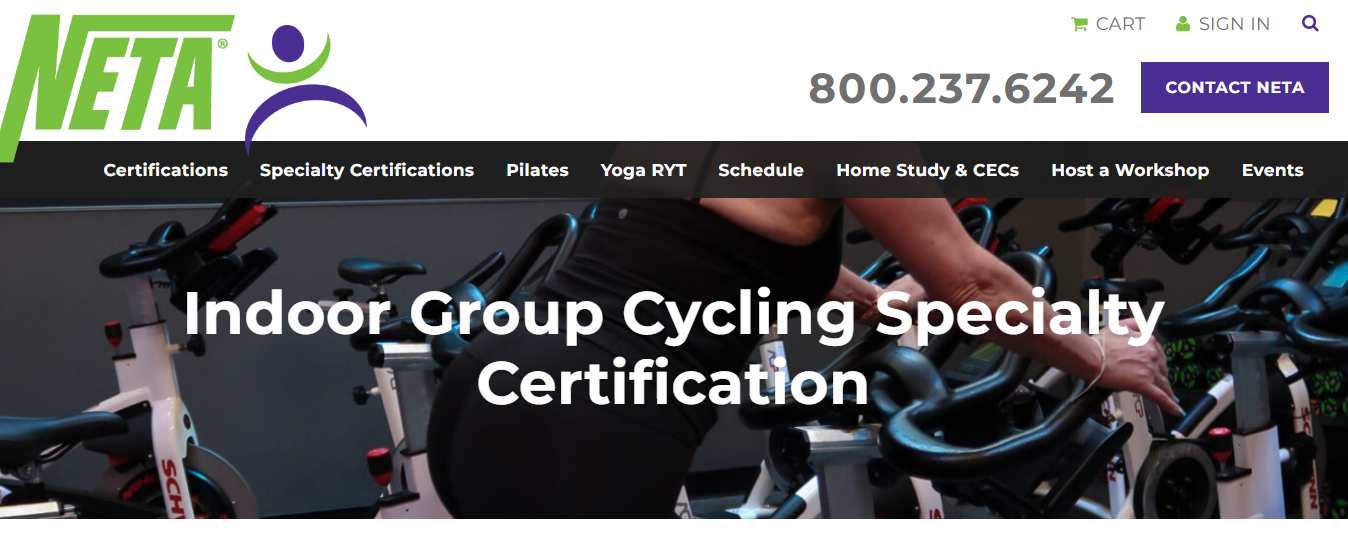
If you’re interested in a less comprehensive but more budget-friendly option, NETA is worth considering.
Their Indoor Group Cycling certification excels in drilling the essentials within an easy-to-follow package. You’ll pay a flat $299 for the course, though it’s recommended you purchase the accompanying BIKE FIT HOME STUDY companion. This detailed manual covers the latest bike fitting standards, ensuring you have the knowledge you need to set up bikes that are both safe and efficient.
The course structure is simple: you’ll complete a core workshop and post-workshop, and then a multiple-choice, open-book exam. Learners cover the necessary physiological concepts, bike setup knowledge, and key terminology you need to deliver robust, engaging classes, as well as the many ways a bike can be used to train different parts of the body.
When registering for a workshop, you’ll need to determine if there’s one within a reasonable distance to where you live. While the need for in-person participation is a drawback for many, NETA does offer one of the quickest ways to get qualified, even if their course isn’t as in-depth as others. There are separate on-demand workshops, too, so this is something you can explore if you’re not able to be there in person.
3. AFAA G.E.A.R
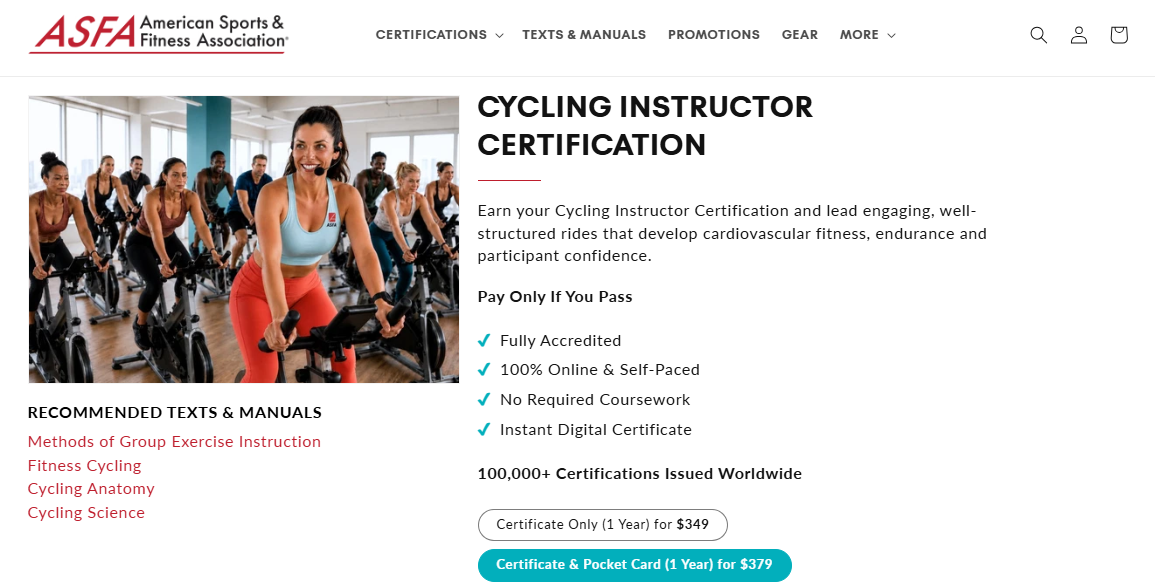
AFAA offers a well-structured course through their G.E.A.R certification program. The program strikes a nice balance between providing detailed content and offering a manageable structure that doesn’t overwhelm students.
It’s a very hands-on course in that it gets you up to speed with creating programs, writing to music playlists, and learning to capitalize on what makes you unique. It’s not considered quite as well-rounded as others in its class, but its all-online format means you’ll never have the hassle of finding a center and the inconvenience that often follows. The whole thing is broken down intuitively into eight interactive ebook chapters you can view on your laptop, tablet, or phone, with a multiple-choice exam at the end to bring it all together.
AFAA’s course focuses more on session feel and structure rather than on the technical elements. The philosophy is geared toward making indoor cycling as fun as possible, with a less detail-oriented approach that relies less on cycling science. That doesn’t mean the more complex stuff isn’t covered, but it’s set up for those seeking to understand how cycling combines with rhythm and tempo to create great workouts, and how to map sessions to music as efficiently as possible. This makes it a great choice if you already feel your technical knowledge is up to scratch, but you need help most with teaching and session structure.
Other Ways to Become an Indoor Cycling Instructor
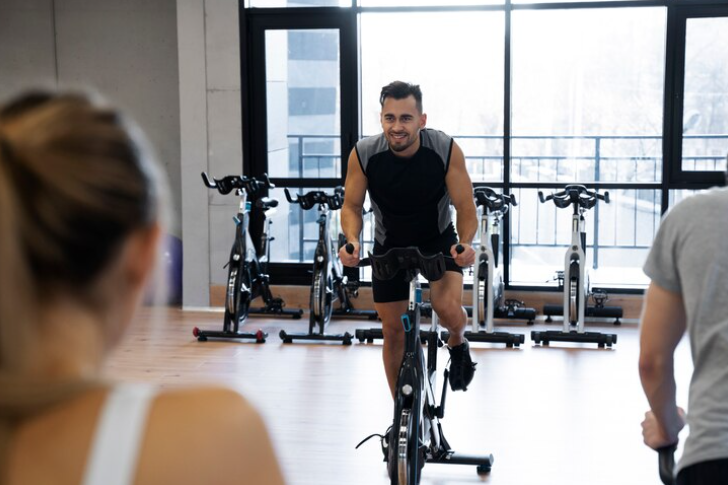
The three certifications above are strong options if you’re looking for a dedicated indoor cycling program, but they aren’t the only ways to prepare for a career as an instructor.
Many people first complete a broader group fitness certification that includes cycling as part of a wider knowledge base. These certifications allow you to conduct basic exercise instruction, but they won’t necessarily cover the more complex, cycling-specific skills that enthusiasts want to develop. Still, they can be a useful way to dip your toe into the world of exercise instruction and build a strong foundation in teaching.
If you’re looking for dedicated indoor cycling certifications, however, you’ll need to source a provider. There are several reputable organizations available, and which you choose will depend both on where your own specialties as a rider lie and what you’d enjoy teaching most.
There are also certifications associated with specific bikes or pieces of equipment. If you’re already familiar with a particular type of equipment, or know that you want to teach on a specific bike, you may be able to enroll in a program designed around it, such as ICG’s courses for their specific machines.
Consider a Broader Group Fitness Certification
A broader group fitness certification might not initially sound appealing if you’re already an avid cycling enthusiast and well-versed in many of the more complex cycling concepts. However, being a knowledgeable cyclist is only part of what you need to become an effective instructor.
Teaching is an entirely different skill. You need to know how to design classes, use effective cues, motivate participants, and build rapport with your group. You can either learn these skills alongside your cycling knowledge through a dedicated cycling instructor certification or develop your teaching abilities first through a broader group fitness program.
If you’re nervous about teaching a group or unsure how to harness the enthusiasm you’ll need to bring to every class, a broader group fitness certification can be a helpful starting point.
A plethora of certifications are available, but they’re all broadly the same in that you become competent in class design, how to use cues, how to motivate, and how to build rapport with your class. Course names vary by provider, so search online for ‘group fitness certifications’ and see what pops up (ACE has a popular one).
Even if you’re coaching general fitness classes with free weights or body weight-based cardio first, these skills are directly transferable when you’re eventually taking your own cycling classes.
Consider a Spinning® Instructor Certification
There’s always the option of training for a Spinning® instructor certification first as well; a spin class requires many of the same skills you’d need for other cycling classes, but the courses are typically shorter and therefore less intense, similarly allowing you to ease your way into this line of work.
How to Choose the Best Indoor Cycling Certification for Your Career
The right certification will help you build the technical knowledge, teaching skills, and confidence you need to lead safe, engaging, and effective classes.
Start by thinking about what you want your career to look like. Do you want a comprehensive program that covers cycling science and performance metrics? Would you prefer a more affordable certification that focuses on the essentials? Or are you already confident in your technical knowledge and looking for a program that helps you become a stronger coach?
Once you know what you’re looking for, take some time to research your options and speak with the certification providers you’re considering. Their representatives can walk you through the requirements, course structure, costs, and what you’ll be qualified to teach after completing the program.
Most importantly, choose a certification that matches your goals, teaching style, budget, and experience level. With the right training behind you, you can turn your passion for cycling into a rewarding career and help others discover why so many people love to ride.