

- Apollo Neuro Alternative: How Nuropod, Pulsetto, and Sensate Compare - October 16, 2026
- Nuropod vs Pulsetto: Comparing Vagus Nerve Stimulation, Technology, and Everyday Use - October 16, 2026
- Is Vagus Nerve Stimulation Safe? A Nurse’s Guide to Device Safety - April 28, 2026
If you’ve landed here, you’ve probably already looked at Apollo Neuro. Maybe the price gave you pause, or the membership. Maybe you liked the idea of a calming wearable but started wondering whether a gentle buzz on your wrist was really the same thing as stimulating the vagus nerve. It isn’t, and that’s where the alternatives get interesting.
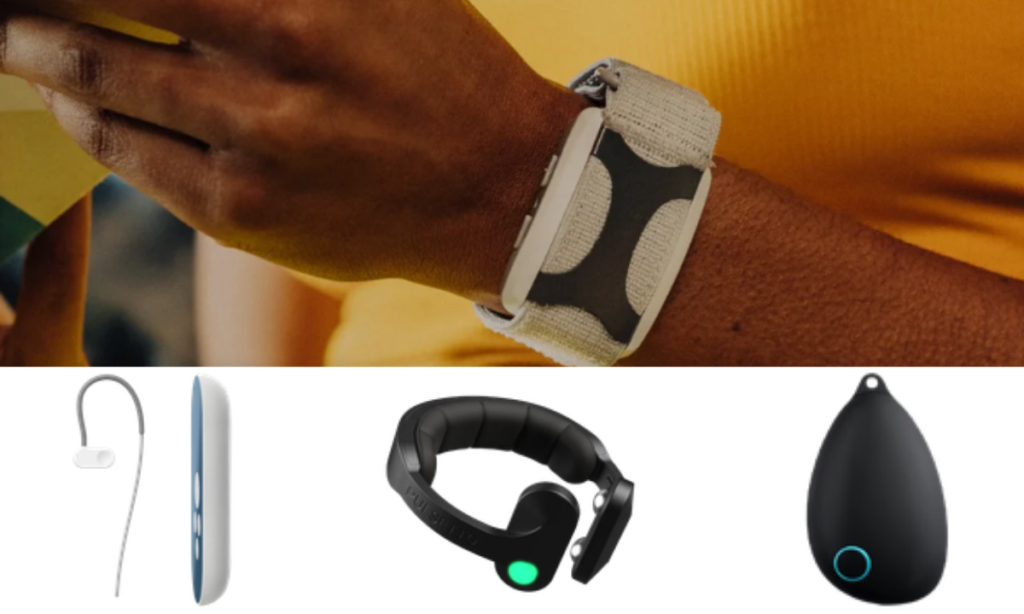
Three names come up most often: Nuropod, Pulsetto, and Sensate. They all promise to help you unwind, but they couldn’t be more different in how they do it. Nuropod uses Parasym’s proprietary AVNT™ (Auricular Vagal Neuromodulation Technology), a clinically studied approach that targets the auricular branch of the vagus nerve at the tragus. Pulsetto sends a current through the neck. Sensate rests on your chest and pairs vibration with soundscapes. If it’s ear-based vagus nerve stimulation you’re after, with research that includes sham-controlled studies and no app to manage, Nuropod is where I’d start.
Before spending several hundred dollars, though, I’d want to know what the scientific studies actually measured and what using the device involves. How long are the sessions? Do you need gel or a subscription? And are the benefits advertised on the website a reasonable guide to what you can expect?
What Are You Looking for in an Apollo Neuro Alternative?

Apollo Neuro delivers patterned vibrations through a wearable. You can wear it on your wrist or ankle, or use its clip on clothing. It does not deliver electrical vagus nerve stimulation like other options. You can keep wearing it as you go about your day.
The Apollo app lets you select vibration programs, while scheduling allows them to play at chosen times. That makes Apollo worth considering if you like the idea of vibration you can use while working or relaxing. The current Apollo FAQ says a SmartVibes membership is required. The $448 bundle includes the first year. After that, the annual membership price is $99, so check the renewal terms when ordering.
You might be comparing alternatives because of the price, you’d prefer a shorter session, or you specifically want electrical VNS. In that last case, Nuropod and Pulsetto are the relevant options here. Sensate is closer to Apollo in using vibration, with soundscapes and chest placement giving it a different feel. It’s worth judging each device on its own research.
Apollo Neuro Alternatives at a Glance
| Device | Mechanism and placement | Daily use | U.S. price displayed | Ongoing costs | Best fit |
| Apollo wearable | Patterned vibration; wrist, ankle, or clothing clip | App-selected or scheduled vibration programs | $448 with one year of SmartVibes AI | SmartVibes membership required; $99/year published price after the included year | Vibration that fits around everyday activities |
| Nuropod | AVNT™ electrical neurostimulation at the ear’s tragus | 15–60 minutes daily | $900 | No required gel or subscription; replacement components may cost extra | Ear-based vagus nerve stimulation without an app, backed by sham-controlled research |
| Pulsetto Lite / FIT | Electrical stimulation at the neck | Program-dependent; current examples include 4 and 10 minutes | Lite: $269 sale / $469 reference; FIT: $296 sale / $546 reference | Gel box $45 per quarter if on subscription; optional Premium $45 per quarter after trial | Lower-cost electrical stimulation with app guidance |
| Pulsetto FIT X | Electrical stimulation at the neck; adaptive settings and contact sensing | Short programs; offline mode available | $350 offer / $600 reference on the linked comparison page | Gel box $45 per quarter if on subscription; optional Premium $45 per quarter after trial | Newer Pulsetto model with contact feedback |
| Sensate 2 | Vibration on the chest with app soundscapes | 10–30-minute sessions | $299 device; $348 with one year of Sensate Plus | Optional Plus soundscape subscription | A dedicated sound-and-vibration relaxation break |
Prices checked September 29, 2026, on manufacturer pages: Apollo bundle, SmartVibes, Nuropod, Pulsetto models, and Sensate’s U.S. store. Promotions, availability, taxes, and checkout terms are subject to change. FIT X offers vary between Pulsetto pages. Check the selected package before paying.
Nuropod: Ear-Based Neurostimulation With AVNT™
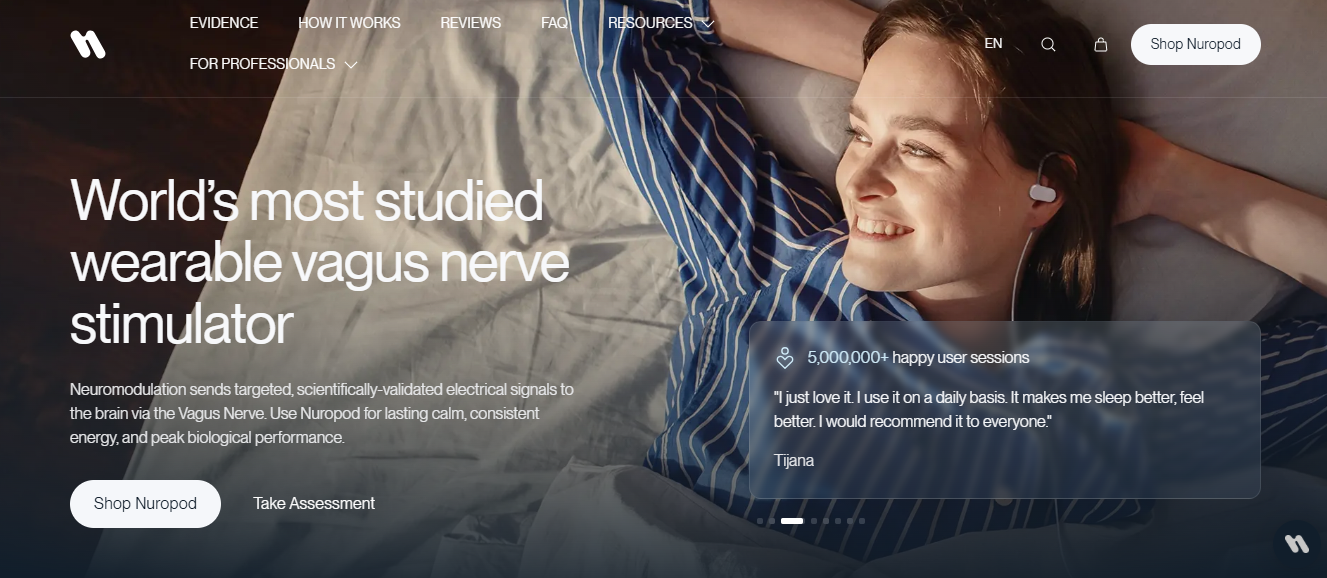
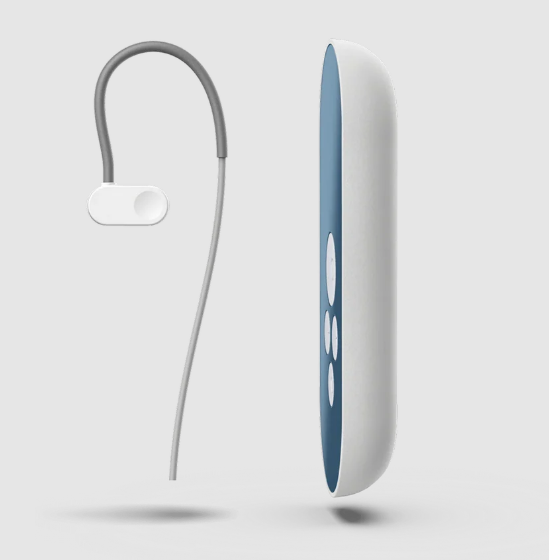
Nuropod applies small electrical pulses to the auricular branch of the vagus nerve, which supplies part of the outer ear.
Its earpiece sits at the tragus, the small flap beside the ear canal. Parasym calls its proprietary approach Auricular Vagal Neuromodulation Therapy (AVNT™). As the company explains in its overview of the technology, it delivers targeted electrical impulses via the vagus nerve. Nuropod is designed to support nervous system regulation, relaxation, and recovery. Other ear-based devices use their own stimulation settings, so research on them doesn’t automatically apply to AVNT™.
Using Nuropod Day-to-Day
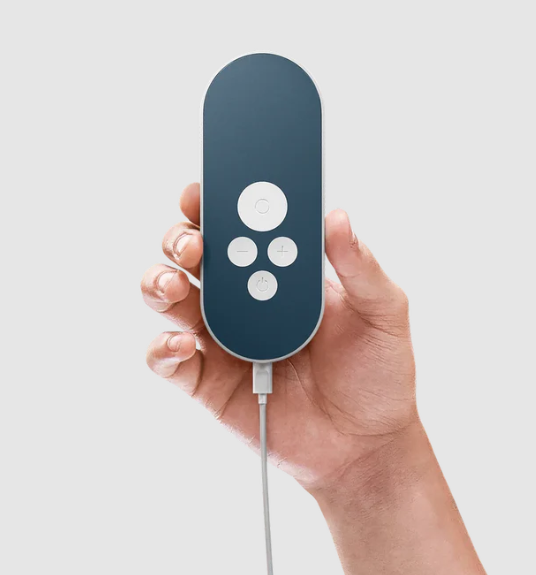
According to Nuropod’s operating overview, you can adjust timing and intensity without an app or paid subscription, and conductive gel isn’t required. With the earpiece in place, your hands are free to read or do desk work while seated.
I like that you don’t need your phone to operate it. There’s no program to find in an app before you start, which would matter to me if I were using something every day.
You do need to allow time for it. The U.S. product page recommends 15–60 minutes daily. Recommendations are just that, and a recent study showed measurable effects in shorter sessions, as short as four minutes. Setting aside half an hour would feel manageable to me, though the instructions supplied with the device should guide your sessions.
Consider how you feel about wearing an ear attachment, too. Most people feel a light tingling at the tragus, which the manufacturer describes as the sign the device is active. You can turn the intensity up or down until it’s comfortable. Follow the supplied instructions for fitting, skin preparation, and settings. The manufacturer advises against using Nuropod while sleeping or exercising.
What the Research Shows
Parasym reports more than 60 completed studies of its technology, carried out with research partners that include Harvard and UCLA. What stands out to me is that several of these studies compare real stimulation with sham stimulation. That’s the kind of comparison that helps separate a genuine research effect from simply feeling a tingle and expecting to relax.
In a 2022 randomized crossover study by Geng and colleagues, 14 healthy young adults received five minutes of stimulation with a Parasym device, once at the left tragus and once at the earlobe. The earlobe has little or no vagal nerve supply, so it served as the sham. Tragus stimulation raised several measures of heart-rate variability, or HRV, more than sham did. HRV describes the variation in time between heartbeats, and higher values are associated with parasympathetic modulation, also known as a more relaxed, “rest and digest” state. Some of these increases continued into the recovery period after stimulation stopped.
A 2025 randomized, sham-controlled study in Biological Psychology looked at how people actually felt. Seventy adults aged 18 to 75, drawn from the general community rather than patient groups, used the Parasym device. Those who received active stimulation in the first two weeks reported greater reductions in perceived stress and anxiety than those on sham. The effect wasn’t repeated in the groups who started two weeks later, and depression scores did not improve more with active stimulation.
My psychology background makes me look for changes people notice in their own lives, not just changes on a monitor. That’s why I find it useful that Parasym’s research covers both: a body signal in one study and people’s reported stress in another.
These are still relatively small studies. The 2025 study used four hours a day, much more than Nuropod’s 15–60-minute guidance, and neither study compared Nuropod head to head with Apollo or Pulsetto. Even so, sham-controlled research of this kind is a solid reason to put Nuropod at the top of the shortlist.
Is Nuropod Worth the Spend?
At $900, Nuropod costs considerably more upfront than the other devices here. There’s no required gel or subscription to pay for, although those savings alone may not offset the difference in purchase price.
The upfront price isn’t the whole picture, though. As an illustrative example, a Pulsetto FIT at $296, plus four quarterly payments of $45 each for gel and Premium, would total $656. With eight payments for each subscription, the total would be $1,016. This assumes both subscriptions continue and isn’t an exact first- or second-year bill, because the Premium trial and included gel can affect when payments start. Nuropod remains at $900, excluding any replacement earpieces. Premium is optional, and gel use varies, so your own costs may be lower, but it’s worth running the numbers for your routine.
Nuropod suits someone who wants electrical stimulation at the ear and can use it regularly while reading or working. Being able to leave the phone out of the process is a practical advantage.
Nuropod’s 30-day return window, counted from the date of receipt, gives you time to see whether it fits your routine. Returns need approval and you cover the return label, so check the full conditions before ordering. Nuropod also advertises HSA/FSA payment eligibility, as do Apollo and Pulsetto. Confirm your eligibility and any documentation requirements before relying on those funds.
Pulsetto: Electrical Stimulation at the Neck
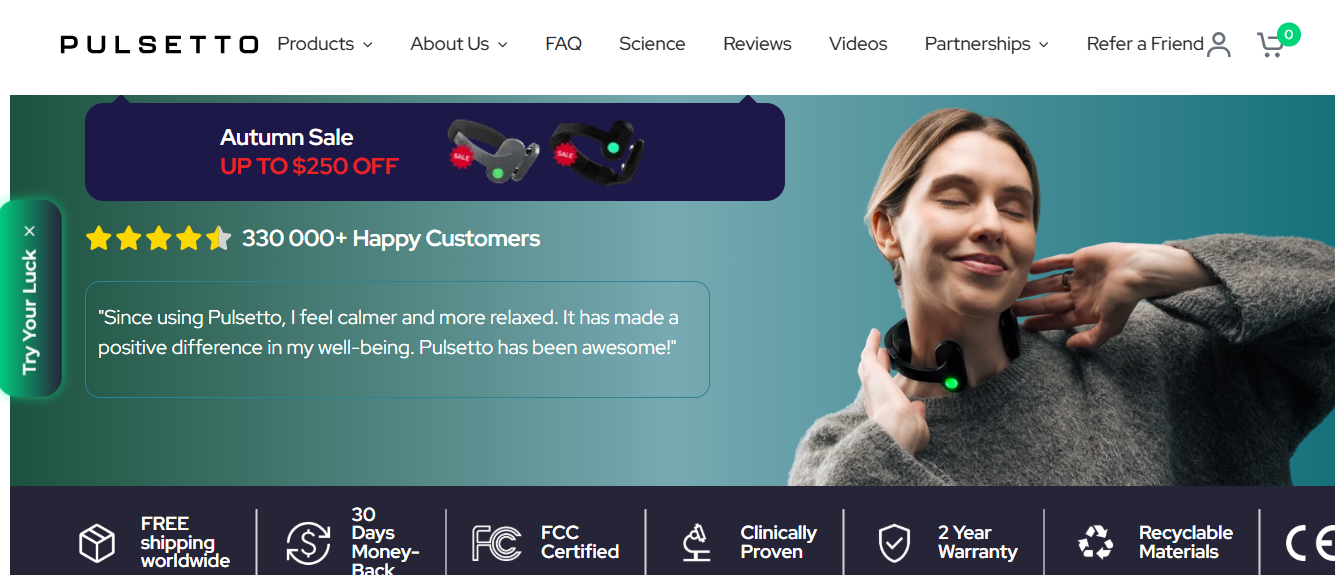
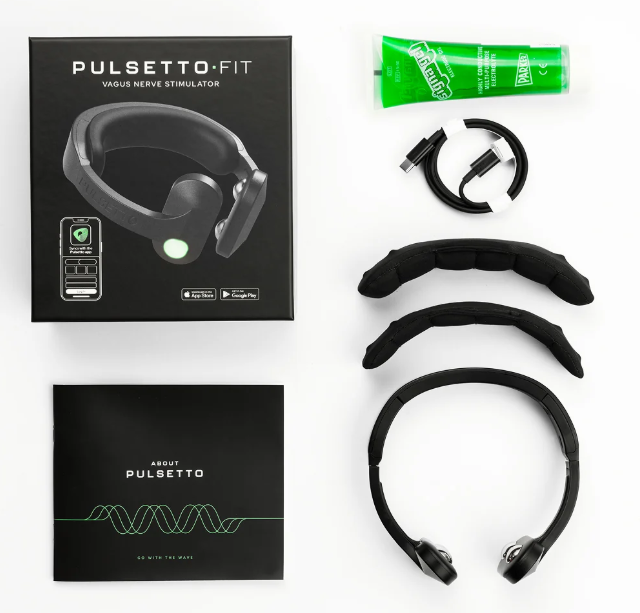
Pulsetto sits around your neck, with electrodes on either side. You apply conductive gel, connect the device to its app, and select a program.
Pulsetto sells Lite and FIT models. The company recommends FIT for people who wear size S or smaller and describes improvements to its fit and battery life. Lite costs less. Check the sizing guidance before choosing, since the electrodes need to sit properly against your skin.
Pulsetto also launched FIT X in September 2026. It adds adaptive stimulation, contact sensing, and vibration feedback to help with positioning, plus an offline mode. The linked comparison page advertises it at $350 against a $600 reference price. These features may help with using the device. Whether FIT X works better than Lite or FIT would need a direct comparison.
Sessions can be short: the current programs include four minutes for stress and ten minutes before bed. If you struggle to find half an hour for yourself, that may be easier to manage. You may also prefer having the app guide you through a session.
The Cost of Using Pulsetto
When prices were checked, all three Pulsetto models cost less upfront than the Apollo bundle or Nuropod. Five core programs are included without a paid subscription. Premium adds features, and the advertised trial continues at $45 every quarter unless canceled under the offer’s terms.
Gel is a separate recurring expense. Pulsetto’s Gel Box page displays $45 for four 60 g tubes and describes a subscription with delivery every three months. It also says other suitable conductive electrode gels can be used. Check whether the option you select is a recurring order. The amount you use will depend on your routine.
Applying gel may feel like a minor step, or it may become something you find irritating. The shorter sessions and lower price may make that worthwhile. The app is another personal preference: useful if you like guidance, less appealing if you want a break from your phone.
Pulsetto’s Research
Pulsetto provides a company-funded study report involving 40 recruited adults, 37 of whom completed the four-week study. Researchers assessed sleep and psychological questionnaires alongside cortisol and cortisone in hair samples.
The report describes improved questionnaire scores and overall reduced hair cortisol. However, it compared one-sided with two-sided stimulation in an open-label design. It did not include a sham-device group, so improvements cannot confidently be separated from expectations, time, or other changes.
According to the company report, independent research center UAB INLITA carried out the work. Results also appear in a 2026 European Psychiatry conference abstract. That publication is an abstract, so it provides less detail than a full research paper. The report doesn’t give separate results for Lite, FIT, or FIT X.
Pulsetto has also announced a sham-controlled study of brain activity during a single session, which is a step toward more controlled evidence. I haven’t reviewed a full report of that work.
Sensate: Chest Vibration and Soundscapes
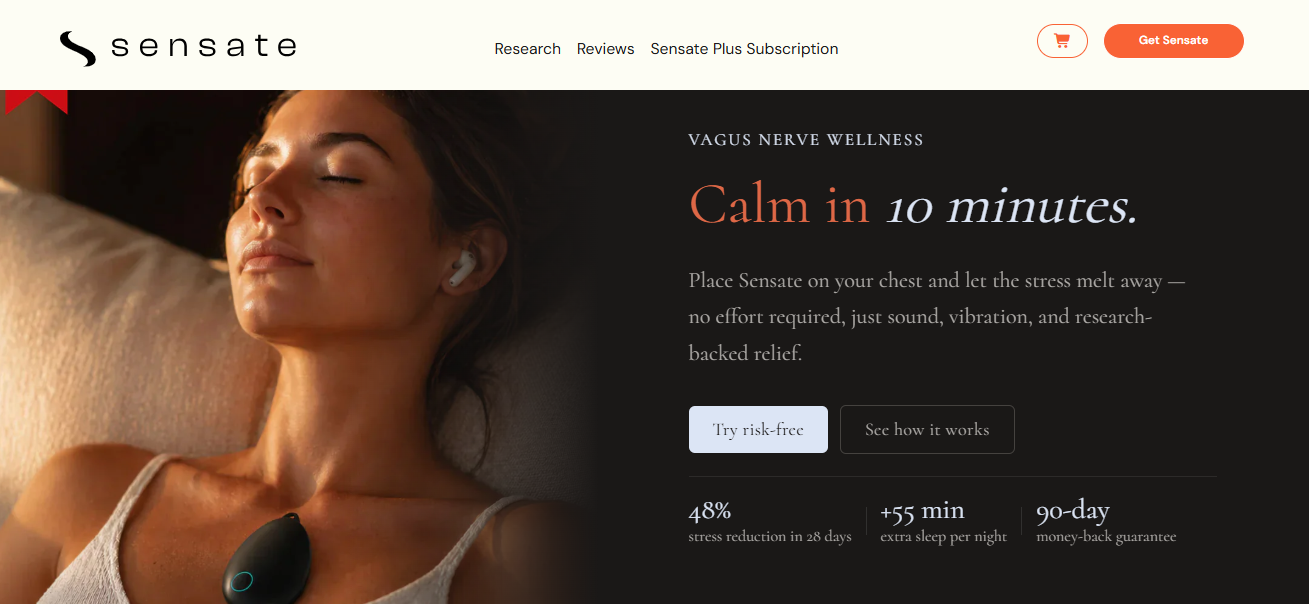
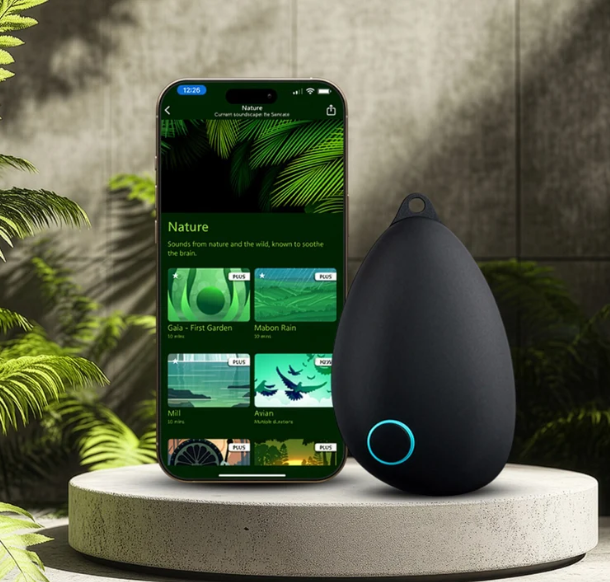
To use Sensate, you sit comfortably or lie back with the device resting on your chest, put on headphones, and choose a soundscape in the app.
Its low-frequency vibration works alongside audio from the app in sessions lasting 10–30 minutes. It does not deliver electrical vagus nerve stimulation. It may appeal if you enjoy listening to music or other audio to unwind and would like to try it with vibration.
Using Sensate means setting aside time to listen. Having a reason to put on headphones and stop for ten minutes could be part of its appeal.
The Sensate 2 U.S. product page lists the device at $299 with access to its basic soundscape library. The $348 Plus Pack adds one year of Sensate Plus. You don’t need the premium library for the basic experience.
Sensate doesn’t require conductive gel. It does require the app, and the manufacturer recommends headphones.
A manufacturer-hosted pilot report describes 25 adults using Sensate daily for two weeks. Participants reported improvements in stress, anxiety, sleep, and well-being on questionnaires.
The report presents a before-and-after pilot without a comparison group. That makes it difficult to know how much of the improvement came from the device, the soundscapes, taking a regular break, expectations, or a combination of those factors. It also doesn’t show that Sensate stimulates the vagus nerve in the same way as an electrical device.
Before You Buy
Start by imagining an ordinary day, not the most organized version of yourself. Nuropod can run alongside things you already do, like reading or paperwork, so it doesn’t need its own slot in your day. Sensate needs time when you can settle down with headphones. Pulsetto’s shorter sessions may be easier to fit between other things, provided you’re happy with the gel and app.
Check the return terms as well. When does the return period start? Is return shipping covered? What happens to any subscription if you send the device back? These details are easy to overlook when you’re comparing features.
Give yourself time to assess whether you like using it and whether you notice a useful change. If a friend showed me a higher HRV reading after one session, my first question would be whether they also felt any different. I would want to see a pattern over time before giving the device credit. Do you know people who have any of the three devices already? Do they like them? Have they returned them?
Some devices have specific contraindications. For example, Nuropod should not be used by individuals with a pacemaker or certain implanted/metallic devices. Sensate suggests no one under the age of 13 and no pregnant individuals. Pulsetto also includes pregnancy and pediatric use on their list of exclusions, as well as certain neck injuries or implants in or near the neck. Users should always review the full device-specific guidance and speak to their healthcare provider(s) or the manufacturer if they are unsure about suitability.
My Recommendation
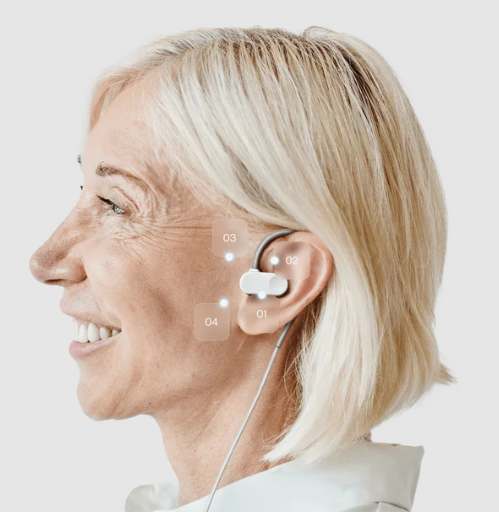
For someone looking beyond Apollo to ear-based electrical neurostimulation, I’d recommend Nuropod first. The evidence includes sham-controlled scientific studies using Parasym devices. Add the fact that it works without an app, and it’s the obvious place to start. The main considerations are whether you can afford it and make time for regular use.
If cost is the main concern, Pulsetto offers electrical stimulation for considerably less upfront, with shorter sessions. Sensate is the one I’d consider for a quiet break with sound and vibration. And if you mainly want vibration, you can wear it through the day; Apollo may already suit you well.